
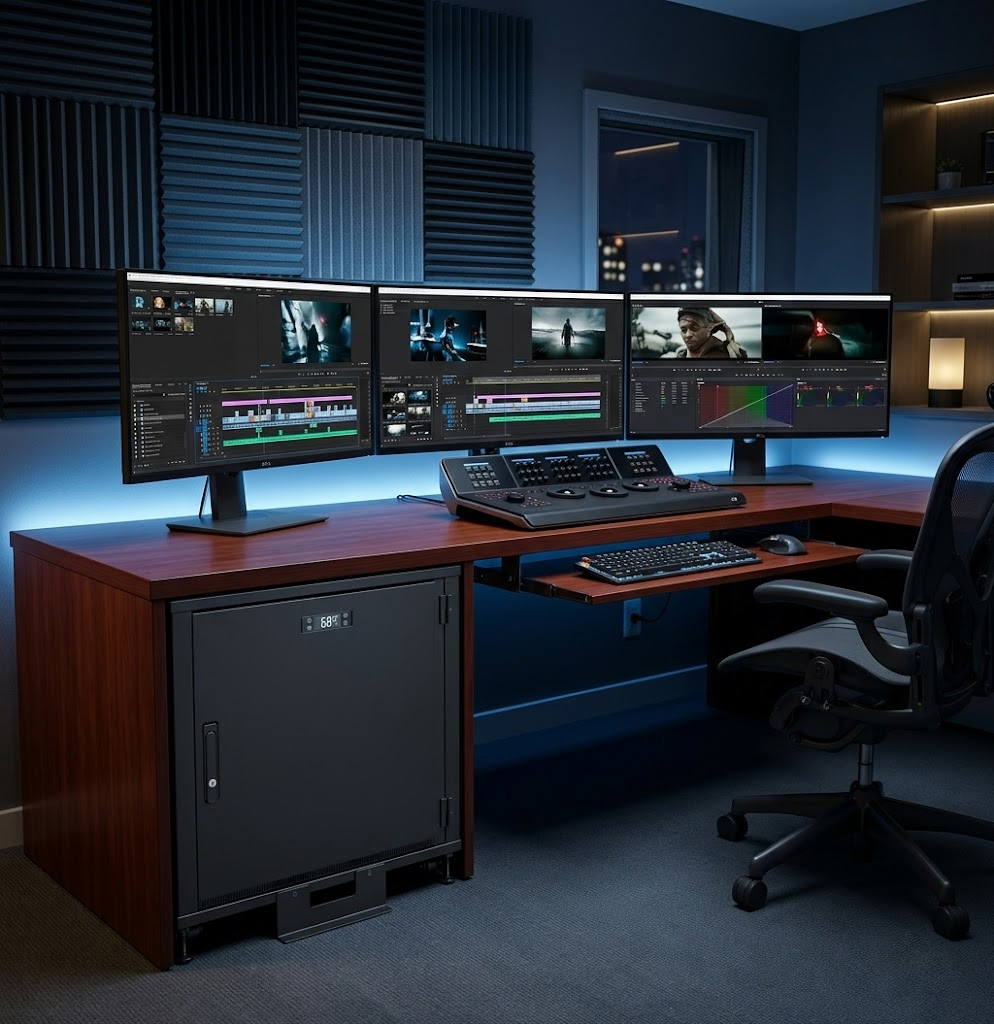
For many organizations, server infrastructure has gradually moved closer to the people who rely on it.
Instead of operating exclusively inside large dedicated data centers, IT equipment is increasingly found in:
- Offices
- Healthcare facilities
- Schools and universities
- Financial institutions
- Retail environments
- Telecom locations
- Edge computing deployments
This shift creates a new challenge:
How do you keep critical IT equipment nearby without creating constant operational noise?
For organizations dealing with noisy servers, fan-heavy networking equipment, or growing rack density, a soundproof server rack can become a practical and highly effective solution.
But when does it actually make sense to invest in one?
The answer depends on the environment, equipment requirements, and how much operational disruption server noise is causing.
What Is a Soundproof Server Rack?
A soundproof server rack—often referred to as an acoustic server enclosure or quiet cabinet rack—is designed to reduce the noise produced by IT equipment while still maintaining airflow, accessibility, and safe operating conditions.
Unlike traditional server cabinets, soundproof racks are engineered with acoustic attenuation in mind.
Their purpose is to help organizations reduce noise from:
- Servers
- Cooling fans
- Switches
- UPS systems
- Storage equipment
- Network infrastructure
while maintaining proper performance.
The objective is not to eliminate sound completely.
Rather, it is to reduce disruptive noise to a much more manageable level.
This becomes particularly valuable when infrastructure exists near occupied workspaces.
Sign #1: Your Server Noise Is Distracting Staff
One of the clearest signs a soundproof rack may be necessary is simple:
People are noticing the noise.
Persistent fan noise can become surprisingly disruptive in offices and shared environments.
Over time, employees may experience:
- Reduced concentration
- Meeting disruptions
- Communication challenges
- General workplace discomfort
Even if teams eventually “tune out” background noise, it may still affect comfort and productivity.
In executive offices or client-facing environments, loud server equipment may also create an unintended impression.
For organizations investing in professional workspaces, reducing infrastructure noise often becomes an operational consideration rather than simply a convenience.
Sign #2: You Don’t Have a Dedicated Server Room
Not every organization has the luxury of a purpose-built IT room.
Many facilities simply do not have:
- Spare infrastructure space
- Dedicated telecom rooms
- Appropriate cooling environments
Instead, IT equipment often ends up in:
- Storage rooms
- Shared workspaces
- Closets
- Open office areas
- Hallways or utility spaces
In these situations, a soundproof server rack may provide a practical way to deploy infrastructure safely without disrupting surrounding areas.
This is especially common in smaller office environments and distributed edge deployments.
Sign #3: You Need Infrastructure Close to Operations
Some environments intentionally place technology near operational teams.
For example:
Healthcare facilities
Critical systems often need to remain close to departments and equipment.
Schools and universities
Infrastructure may be distributed across buildings rather than centralized.
Manufacturing environments
Local computing may support automation systems.
Retail and hospitality
Edge infrastructure increasingly supports digital experiences.
In these environments:
proximity matters.
But proximity often introduces noise concerns.
A soundproof rack allows organizations to keep equipment nearby while creating a quieter operational environment.
Sign #4: Your IT Equipment Is Growing More Dense
As organizations scale their technology infrastructure, equipment density tends to increase.
More equipment means:
- More cooling demand
- More fan activity
- More noise
What once felt manageable can gradually become problematic.
This often happens when organizations add:
- New servers
- Higher-performance equipment
- Additional switching hardware
- Backup systems
- Edge compute environments
At a certain point, traditional rack environments may no longer provide a comfortable experience for nearby occupants.
Sign #5: Noise Is Affecting Customer or Client Experience
For organizations with customer-facing environments, server noise can become surprisingly noticeable.
Examples include:
- Executive offices
- Healthcare waiting areas
- Conference spaces
- Educational settings
- Retail environments
Constant fan noise may affect how a space feels.
Even if visitors cannot identify the exact source:
persistent equipment noise changes the environment.
A quieter infrastructure strategy may help maintain a more professional and comfortable setting.
Why Not Just Move the Rack Somewhere Else?
Sometimes relocation is possible.
But not always.
Organizations may face limitations such as:
- Lack of available space
- Cabling constraints
- Building layout restrictions
- Network performance considerations
- Budget limitations
In these situations, moving equipment may not be practical.
A soundproof rack may offer a more realistic solution while maintaining accessibility and operational performance.
Not All Soundproof Server Racks Are Equal
An important consideration:
Noise reduction should never come at the expense of thermal performance.
Simply placing noisy equipment inside an enclosed cabinet is not enough.
Poor enclosure design can create:
- Overheating risks
- Restricted airflow
- Thermal hotspots
- Equipment instability
The best acoustic rack solutions are engineered to balance:
Noise reduction
Cooling performance
Accessibility
Equipment reliability
Organizations evaluating acoustic rack solutions should always consider airflow and thermal management alongside sound attenuation.
Choosing the Right Acoustic Rack Solution
The ideal soundproof rack depends on several factors, including:
- Equipment size
- Heat load
- Noise reduction goals
- Rack dimensions
- Service access requirements
- Space limitations
For some organizations, moderate sound attenuation may be enough.
Others may require more substantial acoustic control depending on the environment and sensitivity to noise.
At Karis Technologies, Quiet Cabinet Rack (QCR) environments are increasingly helping organizations reduce infrastructure noise while maintaining the performance and reliability their IT environments require.
Final Thoughts
Server noise is often treated as a minor annoyance—until it begins affecting productivity, comfort, or the usability of a space.
For organizations operating IT infrastructure close to people, a soundproof server rack can provide an effective balance between accessibility and acoustic control.
If noisy infrastructure is becoming disruptive, it may be time to evaluate whether a quieter rack environment makes sense.