
As organizations continue to expand their IT infrastructure, one challenge is becoming increasingly difficult to ignore:
Noise.
Servers, switches, cooling fans, UPS systems, and networking equipment generate significant sound, particularly in environments where equipment must operate continuously.
In traditional data centers, this is rarely an issue. Dedicated infrastructure rooms are designed to isolate equipment from staff and building occupants.
However, many modern IT environments do not operate inside large purpose-built facilities.
Today, organizations often place mission-critical technology in:
- Offices
- Healthcare environments
- Educational facilities
- Financial institutions
- Retail environments
- Telecom sites
- Edge computing deployments
In these settings, server noise quickly becomes more than an inconvenience.
It becomes an operational problem.
This is where Quiet Cabinet Racks (QCRs) come in.
What Is a Quiet Cabinet Rack?
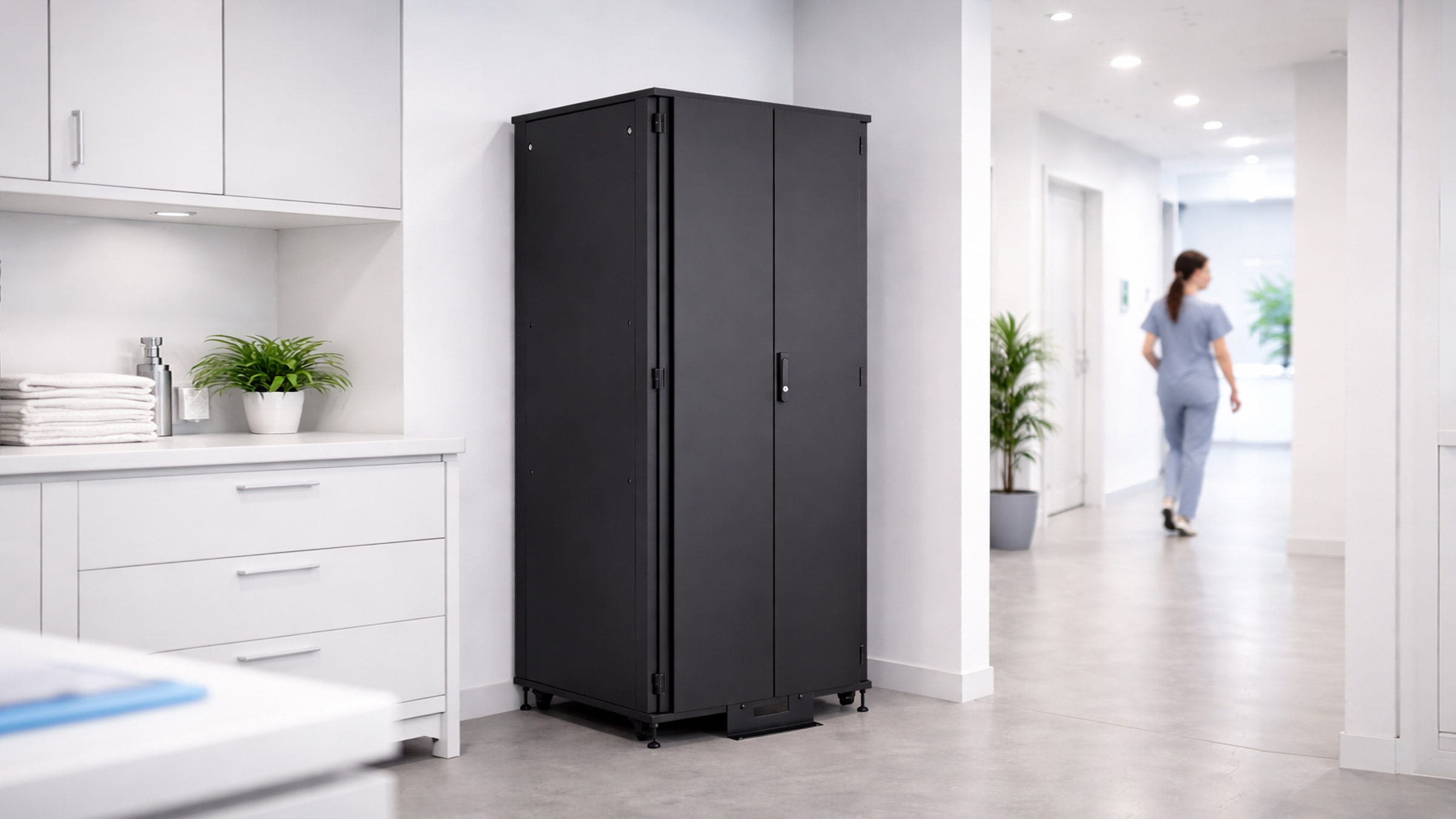
A Quiet Cabinet Rack (QCR) is a specially engineered enclosure designed to house IT infrastructure while significantly reducing operational noise.
Unlike traditional open-frame server racks or standard cabinets, QCRs are built with acoustic noise reduction in mind.
Their purpose is to create a quieter environment around IT infrastructure without sacrificing equipment accessibility, airflow, or performance.
Depending on the application, a QCR may house:
- Servers
- Network switches
- Telecom equipment
- UPS systems
- AV infrastructure
- Storage hardware
- Edge computing systems
The goal is simple:
Keep mission-critical equipment operating effectively while reducing disruptive sound levels in occupied environments.
Why Are Server Environments So Loud?
Many organizations underestimate how much noise modern IT equipment produces.
Servers generate heat, and cooling fans work continuously to manage thermal loads.
As rack density increases, fan speed and cooling demand often increase as well.
Additional sound sources can include:
- Network switches
- Cooling systems
- Power distribution equipment
- UPS units
- Storage arrays
In smaller rooms or office environments, the combined effect can be substantial.
A server rack located near workspaces may create:
- Constant background noise
- Employee distraction
- Reduced workplace comfort
- Communication challenges
- Executive or client-facing concerns
For healthcare or education environments, excessive equipment noise can be especially problematic.
How Does a Quiet Cabinet Rack Work?
A Quiet Cabinet Rack reduces noise through a combination of acoustic engineering and airflow management.
Rather than simply enclosing equipment and trapping sound, well-designed QCRs are engineered to balance:
Acoustic attenuation
Materials and cabinet construction help reduce noise transmission from internal equipment.
Airflow management
Cooling pathways are maintained to support equipment performance.
Thermal control
Heat generated by IT systems must still be managed effectively.
Accessibility
Technicians still require service access and cable management.
This balance is important.
Simply placing servers inside a sealed cabinet is not enough.
In fact, poor enclosure design can create overheating risks.
Effective Quiet Cabinet Racks are designed to reduce sound while maintaining safe operating conditions for equipment.
Where Are Quiet Cabinet Racks Used?
QCRs are increasingly common in environments where dedicated server rooms are unavailable—or where equipment must remain close to operational teams.
Common applications include:
Office environments
Organizations often need local IT infrastructure without disrupting employees.
Healthcare facilities
Noise-sensitive settings benefit from quieter infrastructure placement.
Educational institutions
Schools and universities may require secure IT equipment near occupied spaces.
Financial institutions
Quiet, secure environments are often essential.
Edge computing deployments
Smaller distributed infrastructure locations frequently lack purpose-built IT rooms.
Audio-visual and broadcast applications
Noise control can be critical near production environments.
In many cases, QCRs allow organizations to place infrastructure closer to where it is needed while minimizing disruption.
Quiet Cabinet Rack vs Traditional Server Rack
A traditional server rack is primarily designed for:
- Equipment organization
- Accessibility
- Cooling airflow
- Cable management
Noise reduction is generally not a priority.
A Quiet Cabinet Rack, however, is engineered with additional objectives:
| Traditional Rack | Quiet Cabinet Rack |
|---|---|
| Equipment organization | Equipment organization |
| Basic airflow | Optimized airflow |
| Minimal acoustic control | Significant sound attenuation |
| Data center environments | Occupied spaces & mixed-use environments |
This distinction matters for organizations operating outside traditional data centers.
A standard rack may work perfectly in a dedicated server room.
But in an office, healthcare setting, or executive environment:
noise quickly becomes a consideration.
Why Noise Reduction Matters More Than Many Realize
Noise is often viewed as a secondary issue until it begins affecting day-to-day operations.
Persistent server noise may contribute to:
- Workplace distraction
- Reduced productivity
- Meeting disruptions
- Occupant discomfort
- Poor user experience
In some environments, excessive equipment noise may also affect perceptions of professionalism.
Organizations increasingly expect IT infrastructure to remain effective without dominating the surrounding environment.
This is one reason acoustic enclosure solutions have become more important in recent years.
Choosing the Right Quiet Cabinet Rack
No two environments are exactly the same.
The right QCR solution depends on factors such as:
- Equipment density
- Cooling requirements
- Sound attenuation goals
- Rack size requirements
- Service accessibility
- Available floor space
Organizations evaluating acoustic rack solutions often benefit from considering both thermal performance and acoustic performance together, rather than treating them as separate issues.
At Karis Technologies, Quiet Cabinet Rack (QCR) environments are increasingly being used to help organizations deploy IT infrastructure in occupied spaces where reliability, accessibility, and noise reduction all matter.
Final Thoughts
As IT infrastructure continues moving beyond traditional server rooms, organizations are increasingly facing a new challenge:
How do you keep mission-critical technology close without letting it disrupt the environment around it?
Quiet Cabinet Racks provide an effective answer.
By combining acoustic engineering with proper airflow and equipment access, QCRs help organizations reduce noise while maintaining the performance and reliability their infrastructure demands.
For environments where server noise is no longer acceptable, the right acoustic enclosure strategy can make a meaningful difference.